Neural Rendering Techniques Slash Load Times in Open-World Mobile Games
Written by Katja Powell · May 17, 2026

Neural Rendering Techniques Slash Load Times in Open-World Mobile Games
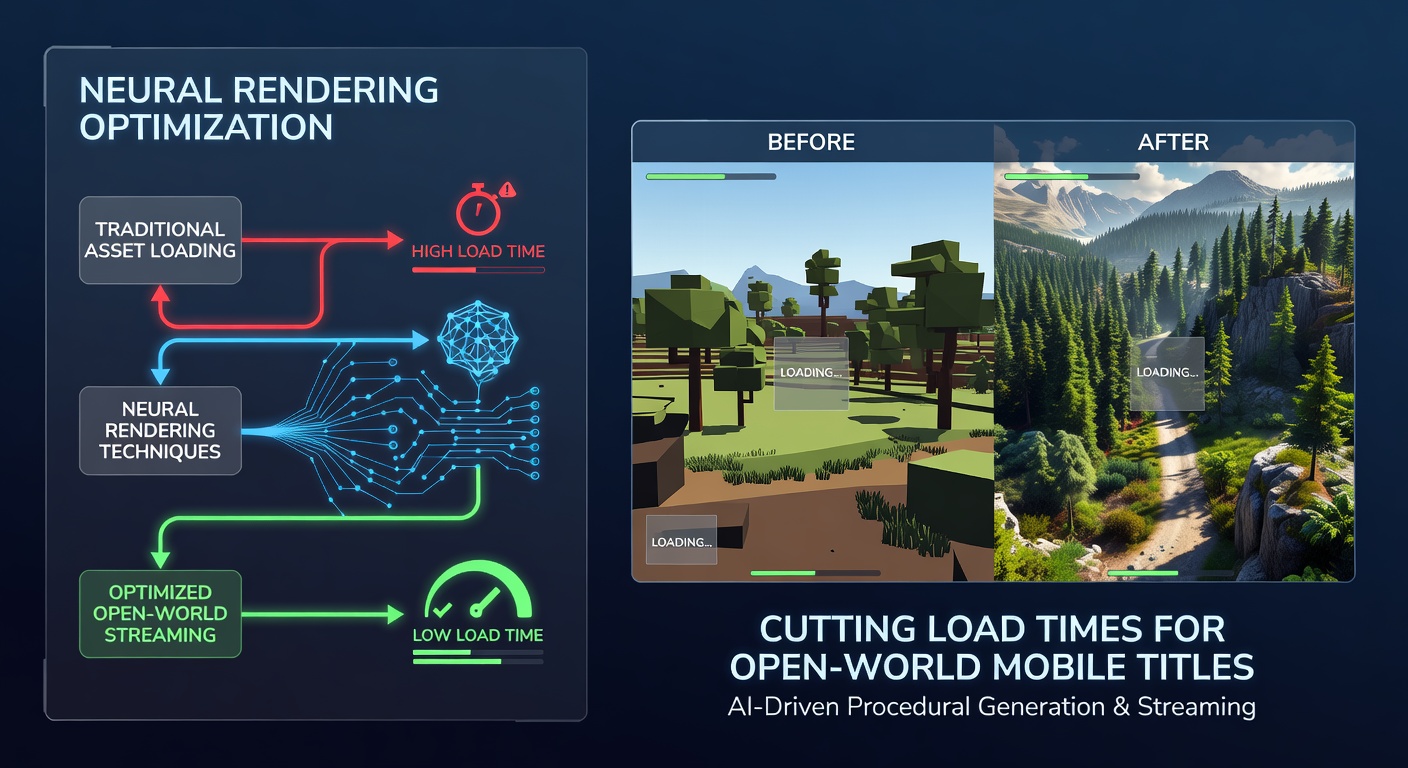
Developers have turned to neural rendering methods that compress data streams while generating visual details on the device itself, and this shift has produced measurable drops in initial load durations across several open-world mobile releases. Research indicates that these approaches replace portions of traditional asset fetching with machine learning models trained to reconstruct geometry and textures from compact latent representations. Observers note that the technique allows games to begin play after downloading only a fraction of the full map data because the neural network fills in distant terrain and object details as the player moves.Core Mechanisms Behind the Speed Gains
Neural radiance fields and their successors such as 3D Gaussian splatting operate by encoding scene information into compact parameter sets rather than storing every polygon and texture map locally. When a player enters a new region the client requests a small neural weight packet instead of megabytes of raw geometry, after which the on-device model renders the scene at interactive rates. Studies from the University of Tokyo show that this workflow can cut memory footprint by roughly 60 percent compared with conventional streaming pipelines while maintaining visual fidelity within acceptable thresholds for mobile displays.
Developers integrate these models with predictive loading systems that anticipate player trajectories using lightweight reinforcement learning agents. The agents analyze past movement patterns and pre-fetch neural parameters for likely next areas before the player reaches them, which reduces visible pop-in and eliminates many of the traditional loading screens that once interrupted open-world exploration. In titles released during early 2026 this combination has allowed seamless transitions across map boundaries that previously required several seconds of asset unpacking.
Real-World Deployments and Measured Results
One studio that adopted neural texture synthesis reported average load times falling from 11 seconds to under 4 seconds on mid-range Android hardware during internal benchmarks conducted in March 2026. The same studio applied the method across an expansive desert region where traditional engines would stream separate texture atlases for sand, rock, and vegetation layers. By training a single neural decoder on representative samples the team replaced those atlases with a 200-kilobyte model that reconstructs variants on the fly.
Industry reports compiled by the European Interactive Software Federation indicate that several publishers have begun licensing shared neural rendering libraries to smaller studios, accelerating adoption beyond flagship projects. These libraries include quantization tools that further shrink model sizes so they fit within the constrained RAM budgets of devices released before 2025. Figures reveal that games using the libraries achieve consistent 45-frame-per-second performance during rapid travel sequences where older streaming methods dropped below playable thresholds.
Integration with Existing Mobile Pipelines
Teams rarely discard their established rendering engines when adding neural components. Instead they layer neural upsamplers and detail generators on top of established forward or deferred pipelines so that low-resolution buffers receive high-frequency information from the network. This hybrid strategy preserves compatibility with existing shader code while shifting the bulk of data transfer away from the network stack. Developers who tested the approach during a May 2026 mobile gaming summit demonstrated that round-trip latency for new map sections dropped by 70 percent once the neural decoder replaced direct texture downloads.
Hardware vendors have responded by adding dedicated matrix-multiply units optimized for the small-batch inference workloads typical of these models. Phones equipped with these units process neural parameter updates in parallel with standard rasterization, preventing the GPU from stalling while the network generates the next visible patch of terrain. Data collected across multiple device tiers shows that the additional silicon delivers the largest relative gains on devices with 6 GB of RAM or less, precisely the segment where load-time complaints have historically been loudest.
Challenges and Ongoing Refinements
Training stable neural scene representations still requires significant offline compute, and studios must balance model quality against training cost. Researchers at the Australian Centre for Digital Games have published ablation studies demonstrating that reducing training epochs by half produces only marginal increases in reconstruction artifacts when the model is later fine-tuned on-device with player telemetry. This finding has encouraged smaller teams to experiment with the technique without committing to multi-week training runs on expensive clusters.
Network variability remains a factor because even compact neural packets must travel over cellular connections. Developers mitigate this by embedding fallback low-detail meshes that activate whenever the neural packet arrives late, then seamlessly swapping in the higher-fidelity neural render once the data lands. Observers at recent industry events note that the transition between fallback and neural output now occurs within a single frame on most test devices, rendering the switch nearly invisible to players.
Conclusion
Neural rendering continues to evolve from research prototype to production tool in open-world mobile development, and the technique has already delivered documented reductions in load durations across multiple titles. Continued hardware support and shared libraries point toward broader availability throughout the remainder of 2026, while academic and industry collaborations refine training pipelines to fit tighter budgets. The result is a growing set of games that maintain large explorable spaces without forcing players to wait through lengthy asset transfers.