Machine Learning Models Predicting Player Churn Rates and Triggering Personalized Content Updates in Casual Mobile Titles
Written by Cameron Koch · Jun 12, 2026
Machine Learning Models Predicting Player Churn Rates and Triggering Personalized Content Updates in Casual Mobile Titles
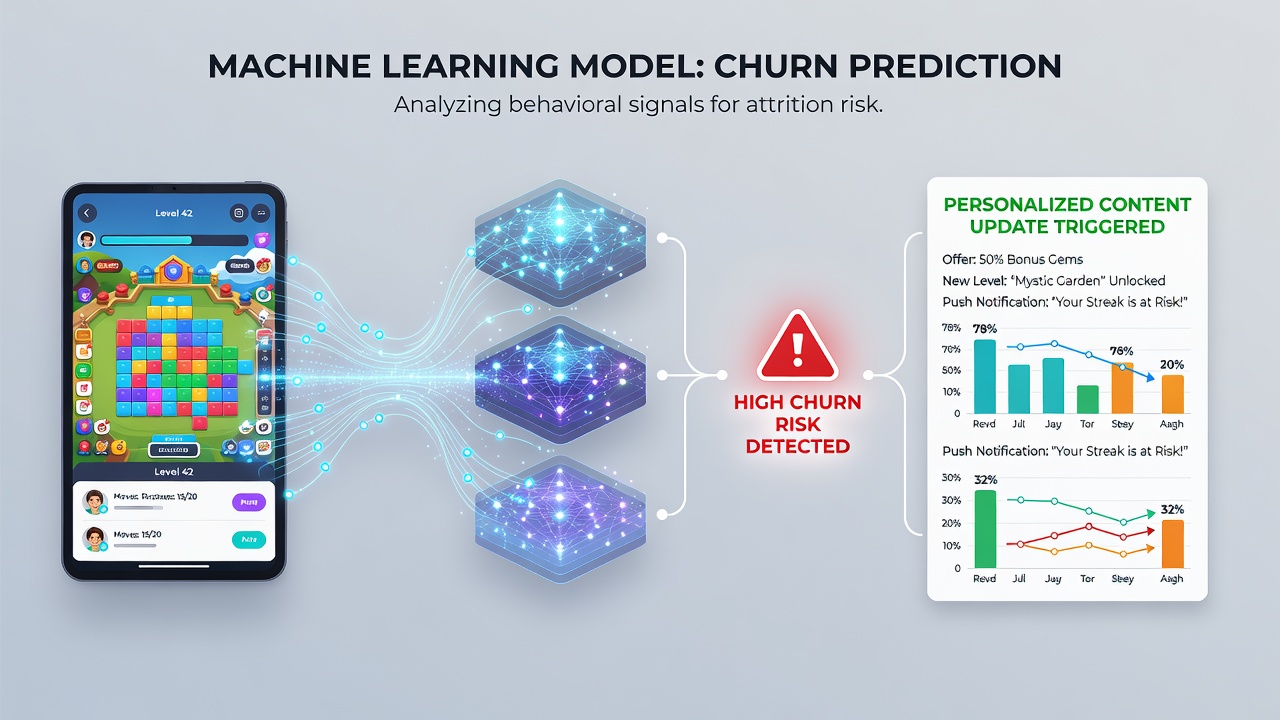
Casual mobile titles rely on machine learning models that process player data including session duration, in-app purchase frequency, level completion rates, and social interaction logs to calculate churn probability scores, and these systems then activate personalized content updates such as custom level packs or reward adjustments when risk thresholds are crossed. Developers integrate these models into backend pipelines where real-time inputs from millions of daily active users feed into classification algorithms like gradient boosting or recurrent neural networks that output retention forecasts days or weeks ahead.
Data Inputs and Model Training Processes
Training datasets draw from anonymized telemetry collected across device types and regions, where features such as time spent on specific mechanics, drop-off points in tutorials, and response to previous notifications receive weighting based on historical patterns that correlate with departure. Researchers at the University of Toronto have documented how ensemble methods combine these variables to reach prediction accuracies above 80 percent in large-scale deployments, and models retrain weekly to account for seasonal shifts in play habits. Feature engineering plays a central role here because raw logs require transformation into normalized vectors that highlight behavioral sequences rather than isolated events.
Validation occurs through cross-validation on holdout sets from prior months, and teams compare precision-recall curves against simpler rule-based systems that flag inactivity after fixed thresholds. This approach allows the identification of subtle signals like reduced daily logins following a difficult boss encounter or declining response rates to push notifications.
Triggering Personalized Content Updates
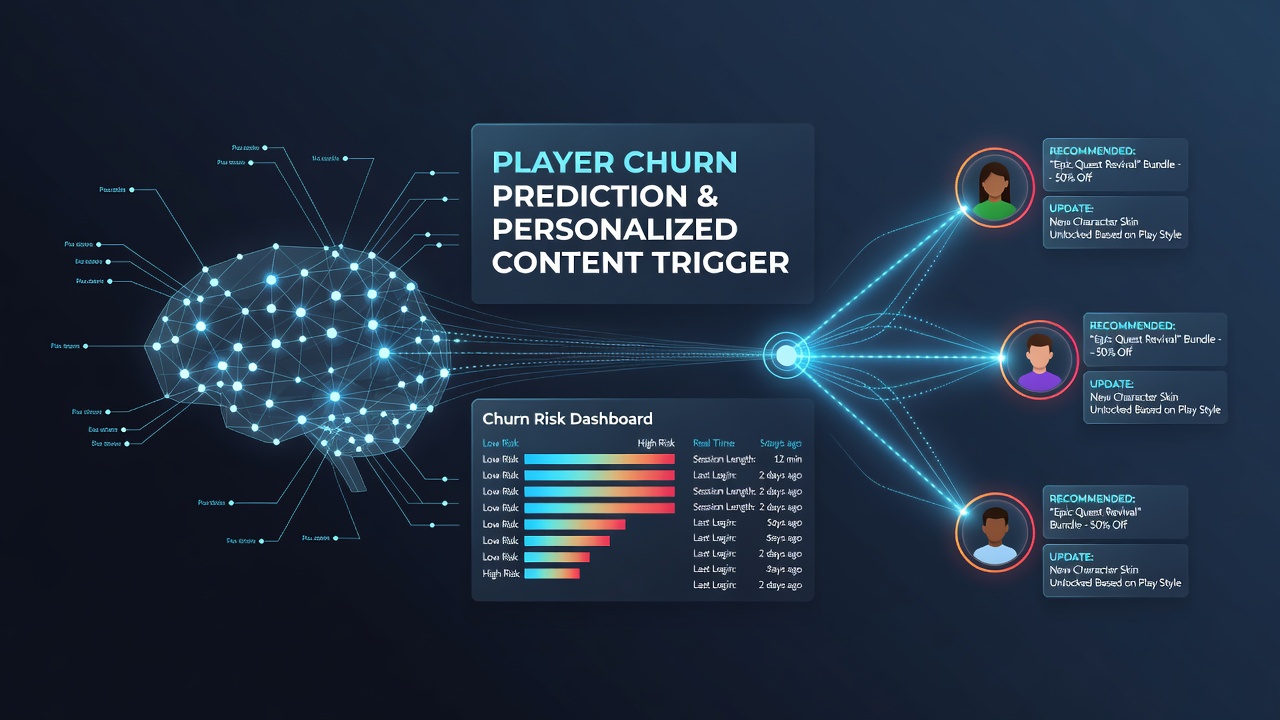
Once a model assigns a high churn score, automated rules launch targeted interventions that include new character skins matched to past avatar preferences, shortened quest chains for players who previously abandoned longer narratives, or boosted resource drops calibrated to individual spending velocity. These updates deploy through server-side configuration files that reach devices without requiring app store resubmissions, and A/B testing frameworks measure uplift in retention metrics within 48 hours of rollout. Data shows that players receiving such tailored adjustments exhibit session length increases of 15 to 25 percent compared with control groups in multiple studio reports.
Integration with Live Operations
Live operations teams monitor model outputs through dashboards that aggregate cohort-level predictions, and they adjust global parameters when aggregate churn forecasts exceed baselines established during soft launch phases. In June 2026 several mid-sized studios reported scaling these systems across portfolios of puzzle and simulation titles after initial pilots demonstrated consistent reductions in 30-day churn rates. The architecture often combines on-device lightweight inference for immediate signals with cloud-based heavy computation for deeper pattern recognition, which keeps latency low while maintaining accuracy.
Privacy considerations shape data pipelines because regulations in the European Union and Canada require explicit consent flows and data minimization practices, and compliance teams audit model inputs to exclude personally identifiable information beyond device identifiers. External audits from organizations such as the Entertainment Software Association have tracked industry adoption of these privacy-preserving techniques across North American developers.
Performance Metrics and Industry Patterns
Key performance indicators include not only churn reduction percentages but also downstream effects on average revenue per user and lifetime value calculations, where models that successfully retain mid-tier spenders produce measurable lifts in these figures. Observers note that casual titles with simpler core loops benefit more readily from this approach than complex strategy games because the narrower feature set produces clearer behavioral signals for training. Multiple case studies from independent developers reveal that combining churn prediction with dynamic difficulty adjustments yields compounded retention gains because players encounter fewer frustration points before disengaging.
What's interesting is how edge deployment on mid-range devices has expanded access to these capabilities, since quantized models now run inference locally for basic risk scoring before syncing with central servers. This hybrid setup reduces bandwidth costs and supports offline play sessions that still contribute to updated profiles upon reconnection.
Conclusion
Overall the combination of predictive modeling and automated content personalization forms a closed-loop system that adapts games to individual trajectories without manual intervention at every step. Continued refinement of these techniques depends on access to diverse training data and ongoing collaboration between data scientists and game designers to ensure that triggered updates align with intended player experiences across global audiences.