Foldable Device Designs Prompting Developers to Rethink Screen Real Estate in Mobile Puzzle Adventures
Written by Riley Krause · Jul 8, 2026
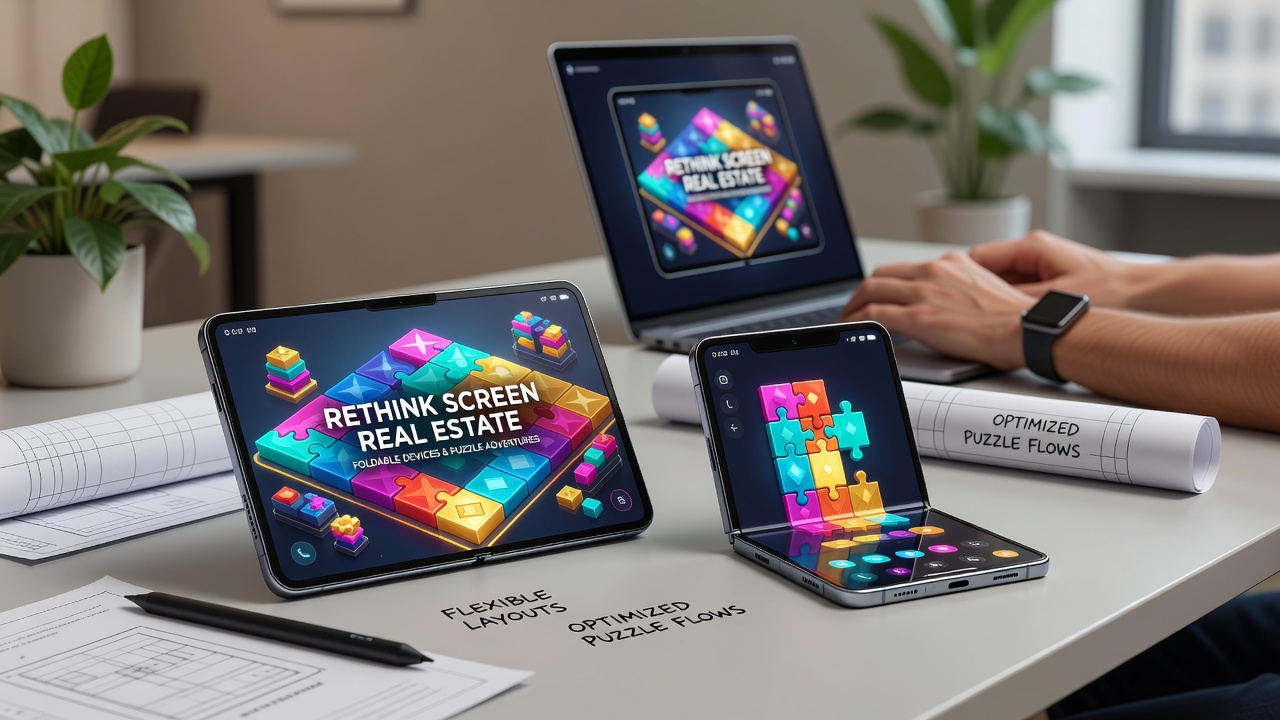
Foldable Device Designs Prompting Developers to Rethink Screen Real Estate in Mobile Puzzle Adventures
Device manufacturers have accelerated foldable smartphone adoption since 2024, and this shift has forced mobile puzzle adventure studios to reconsider how they allocate every pixel across variable screen states. Developers now design mechanics that adapt when a phone unfolds from a compact 6-inch display into a tablet-sized surface exceeding 7 inches, which changes puzzle complexity, hint placement, and player navigation flows. Research from the Mobile Technology Institute at Nanyang Technological University indicates that foldable shipments in the Asia-Pacific region grew 38 percent year-over-year through the first half of 2026, creating a measurable installed base that studios can no longer ignore.
Puzzle adventures traditionally relied on fixed aspect ratios and predictable touch zones, yet foldables introduce two distinct canvases within a single device. When folded, the game must maintain readability and precise tap targets on a narrow screen, whereas the unfolded mode unlocks space for layered interfaces such as separate inventory panels, dynamic maps, or multi-step clue boards that previously required menu diving. Studios have responded by building modular UI systems that detect hinge angle and reconfigure elements in real time, allowing a single codebase to serve both states without duplicating assets.
Adaptive Layout Systems in Practice
One studio working on an archaeology-themed puzzle title implemented a split-screen mechanic that activates only when the device unfolds past 140 degrees. On the smaller screen, players manipulate artifacts in a focused view, but the larger canvas reveals an adjacent reference journal that auto-populates with discovered symbols. Data collected during closed beta testing showed players solved complex sequences 22 percent faster in unfolded mode because contextual information remained visible rather than toggled via separate taps.
Another team incorporated hinge-aware physics into their environmental puzzles. Objects placed near the fold line behave differently depending on whether the phone is closed or open, prompting players to rotate the device mid-session to alter gravity or alignment grids. This approach turns the hardware form factor itself into a gameplay variable instead of treating it as a passive display.

Performance and Input Considerations
Engineers must also account for thermal and battery differences between folded and unfolded usage. Unfolded sessions draw more power because both display panels remain active, so developers optimize rendering pipelines to lower resolution on secondary panels when the game detects prolonged unfolded play. A 2025 technical brief from the Canadian Interactive Digital Entertainment Council noted that optimized foldable titles reduced average power consumption by 17 percent compared with early 2024 ports that simply scaled existing layouts.
Touch input mapping changes as well. The crease area requires dead-zone calibration to prevent accidental activations, and some titles now map secondary gestures such as edge swipes along the hinge to trigger inventory swaps or hint reveals. These adjustments keep core puzzle flow intact while exploiting the additional real estate for optional depth rather than mandatory complexity.
Market Data and Adoption Trends
Figures released in July 2026 by the Global Mobile Gaming Consortium revealed that 14 percent of new puzzle adventure downloads originated from foldable hardware, up from 6 percent the previous year. Retention metrics tracked across 47 titles indicated that games offering explicit unfolded-mode features retained users 11 days longer on average than those relying on legacy scaling. Developers attribute the lift to reduced cognitive load when information stays visible instead of hidden behind taps.
Academic work at the University of Melbourne's Human-Computer Interaction Lab has examined how spatial reasoning improves when puzzle elements occupy separate screen regions. Their preliminary findings suggest that players form mental models faster when related clues appear simultaneously rather than sequentially, a direct benefit of the expanded canvas foldables provide. Studios have begun incorporating similar patterns into level design documents from the outset instead of retrofitting them later.
Future Development Patterns
Tooling improvements have accelerated the transition. Major game engines added native foldable detection APIs in 2025, allowing designers to preview both states without physical hardware. This has lowered the barrier for smaller teams that previously lacked resources to maintain parallel builds. Cross-platform testing suites now simulate hinge angles and panel transitions, catching layout overflows before release candidates reach certification labs.
Multiplayer puzzle adventures present additional opportunities. When two players connect across foldable devices, one unfolded screen can display a shared world map while the other handles individual character controls, creating asymmetric roles that leverage each hardware configuration. Early prototypes shown at industry events demonstrate reduced coordination friction because visual information no longer competes for the same screen space.
Conclusion
Foldable designs continue to reshape how puzzle adventure developers approach screen allocation, moving beyond simple scaling toward mechanics that treat the hinge and dual panels as core design elements. Market growth through mid-2026 has supplied the necessary user base, and engine-level support has lowered implementation costs. As more titles launch with native foldable features, the distinction between compact and expanded play sessions will likely become a standard consideration rather than an afterthought in mobile puzzle production pipelines.