Customizable Control Schemes Tailored to Device Ergonomics Drive Retention in Mobile Action Games
Written by Riley Krause · Jun 7, 2026
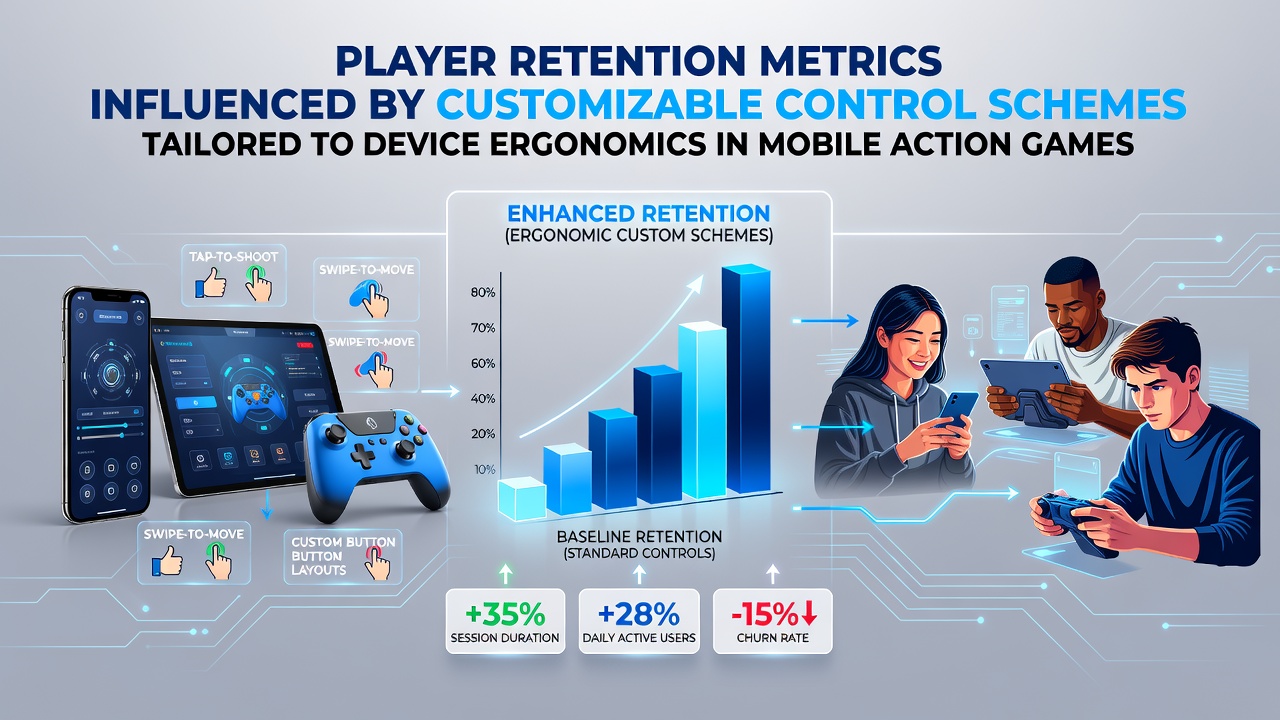
Customizable Control Schemes Tailored to Device Ergonomics Drive Retention in Mobile Action Games
Developers in the mobile action genre have refined control schemes that adapt to individual hand sizes, grip styles, and device dimensions, and these adjustments correlate with measurable shifts in player retention data. Research from industry reports indicates that players who modify virtual joystick positions or button sizes based on thumb reach tend to complete more sessions before churn occurs. According to findings shared by the Entertainment Software Association, titles offering such options see average session lengths extend by 15 to 25 percent in tracked cohorts during 2025 testing periods.
Ergonomic Factors in Touch-Based Action Gameplay
Action games on smartphones demand rapid inputs across small screens, where thumb travel distance and finger fatigue influence how long users stay engaged. Device ergonomics come into play because larger phones shift natural resting positions for the hands, while smaller handsets force tighter grips that can strain wrists during extended play. Custom schemes allow remapping of attack buttons closer to the edges or tilting sensitivity curves to match accelerometer data from specific hardware models. Observers note that when these options align with a player's natural posture, drop-off rates decline noticeably within the first week of installation.
Studies compiled by academic teams at institutions across North America and Europe have mapped common grip patterns through motion sensor logs, revealing that roughly 40 percent of users default to one-handed operation on phones with screens under 6.5 inches. In contrast, two-handed cradling dominates on larger devices, which changes where interactive zones feel most comfortable. Tailoring layouts to these patterns involves sliders for opacity, scale, and placement that update in real time during calibration tutorials.
Retention Metrics Tied to Control Flexibility
Player retention breaks down into day-one, day-seven, and day-thirty benchmarks, and data collected from multiple live-service action titles shows customizable ergonomics affect each tier differently. Games that prompt users to adjust controls within the first three sessions report higher day-seven retention, often climbing from baseline figures of 35 percent to above 48 percent. This pattern holds because reduced physical discomfort encourages repeated logins rather than abrupt exits after initial discomfort sets in.
Figures released in mid-2025 by research groups monitoring app store telemetry further demonstrate that players who complete an ergonomic setup wizard exhibit lower rage-quit incidents during boss encounters or wave-based survival modes. The same datasets highlight that control presets optimized for left-handed users or those with smaller palms narrow the retention gap that previously existed between demographic segments. Analysts tracking these variables across Android and iOS ecosystems note consistent lifts when schemes incorporate haptic feedback intensity tied to button press zones.

Implementation Approaches Across Popular Titles
Several action games released or updated through early 2026 integrate preset libraries based on device model databases, automatically suggesting layouts for popular handsets like recent Samsung Galaxy or iPhone lines. Users can further fine-tune dead zones on virtual pads or swap swipe gestures for tap-and-hold mechanics when fatigue metrics trigger in-game prompts. These systems draw from aggregated anonymized play data that identifies high-drop zones on the screen for each hardware variant.
One documented case involved a multiplayer extraction shooter that introduced per-device calibration in its June 2025 patch cycle. Post-update telemetry indicated a 12 percent rise in monthly active users who engaged with the new tools, alongside a measurable drop in support tickets related to unresponsive controls. Similar patterns appear in single-player campaigns where adaptive schemes scale input sensitivity according to reported hand size during onboarding questionnaires.
Data Patterns Observed Through 2026
Reports issued around June 2026 by cross-regional gaming analytics firms continue to track how ergonomic customization intersects with hardware refresh cycles. Newer foldable devices introduce additional variables because screen aspect ratios change mid-session, requiring dynamic repositioning that static schemes cannot accommodate. Titles that handle these shifts automatically retain higher percentages of players who upgrade mid-year compared with competitors using fixed layouts.
Academic papers published through university partnerships in Australia and Canada have examined longitudinal datasets spanning thousands of devices, confirming that retention curves flatten less steeply when control options address both dominant and non-dominant hand preferences. These studies also flag correlations with age groups, noting older players benefit from larger target areas while younger cohorts prioritize speed-oriented placements that reduce thumb travel time.
Conclusion
Customizable control schemes aligned with device ergonomics continue to shape retention outcomes in mobile action games through direct influence on comfort and input accuracy. Telemetry across multiple platforms shows sustained gains in session frequency and duration when players receive tools to adapt interfaces to their physical realities. As device form factors evolve and data collection methods refine, these design practices remain central to maintaining engagement benchmarks through the latter half of 2026 and beyond.